| |
 |
Archive for General Nutrition & Wellness
August 20, 2014 at 8:49 am
· Filed under Diabetes, General Nutrition & Wellness, Nutrition, Recipes, Wellness
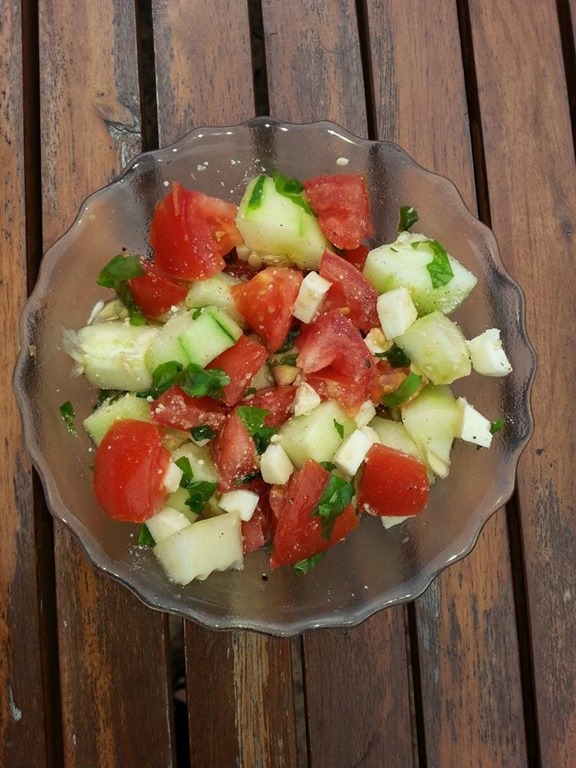
One of our favorite summer-time salads! Very fast to throw together for lunch or as side-dish with a grilled dinner.
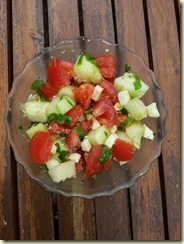
Ingredients:
2 medium tomatoes, chopped
1 medium cucumber (peeled, if desired)
5-6 basil leaves, chopped
2 ounces part-skim mozzarella cheese, cut into bite size chunks
1 T olive oil
1 T red wine vinegar
2 t Italian Blend Mrs. Dash (if desired)
Directions:
Mix the tomatoes, cucumbers, basil and cheese together into two individual serving bowls. Top each salad with 1/2 T olive oil, 1/2 T vinegar and 1t Italian seasoning to each bowl. Makes 2 servings.
Nutrition Facts
1 Serving:
Calories –187.1
 Total Fat – 11.3 g Total Fat – 11.3 g
Saturated Fat – 3.8 g
Polyunsaturated Fat – 0.7 g
Monounsaturated Fat – 6.3 g
Cholesterol – 16.4 mg
Sodium – 151.3 mg
Potassium – 58.3 mg
Total Carbohydrate – 12.0 g
Dietary Fiber – 3.2 g
Sugars – 8.0 g
Protein – 10.0 g
It’s Your Health. It’s Your Life. Make That Change!
Permalink
March 21, 2014 at 10:52 am
· Filed under General Nutrition & Wellness, Professional Interest, Wellness
Have you ever paid attention to your breathing? I know we all have when we get active and realize we are out of breath. But I want to know if you pay attention to your breathing when you are just breathing.  We are a busy society running ourselves all over the place while we multi-task. Can you put down your phone or not check your email or text messages? It’s hard. We have become wired to our society. This constant barrage of information can take a toll on us. Many people complain about how stressed out they become during the day. This daily stress can then lead to sleepless nights, anxious moments, increased irritability, a change in our diet or lifestyles. Stress can have a profound effect on not only our health but also our personal relationships. We can become mindless of things happening around us because we are caught up in everything we were supposed to do or things that are waiting for us to do. Life can get pretty busy. So what can we do? Breathe. That’s right, breathe. We are a busy society running ourselves all over the place while we multi-task. Can you put down your phone or not check your email or text messages? It’s hard. We have become wired to our society. This constant barrage of information can take a toll on us. Many people complain about how stressed out they become during the day. This daily stress can then lead to sleepless nights, anxious moments, increased irritability, a change in our diet or lifestyles. Stress can have a profound effect on not only our health but also our personal relationships. We can become mindless of things happening around us because we are caught up in everything we were supposed to do or things that are waiting for us to do. Life can get pretty busy. So what can we do? Breathe. That’s right, breathe.
Take a moment to sit down and get comfortable. Now, breathe and notice your breath. Notice how your body responds to the steady inhalation and exhalation of a bodily function that happens without us thinking about it. What happens when we start to think about it? Changes occur! While you are breathing, don’t try to control your breath, just let the body do what it is designed to do. All you have to do is notice how your body changes, notice how your muscles respond, how your shoulders and belly move. While you are breathing, other thoughts may enter into your mind. Don’t worry about them. Notice them and let them flow out just like your breath flows out. Return to noticing your breath. As you breathe, you can repeat this great poem from Thich Nhat Hanh:
“Breathing in I calm my body. Breathing out I smile. Dwelling in the present moment, I know this is a wonderful moment.”
Taking a few minutes each day to practice breathing can help you become more aware, more present in the current moment and may help to bring you a bit of calmness and peacefulness to our crazy days. Remember, your breath is always with you. All you have to do is stop and notice it for a few minutes. Practice that everyday for a week and see what happens. I’ll be interested in hearing if you notice any changes!
Happy Friday, enjoy!
~John
It’s Your Health. It’s Your Life. Make That Change!
Permalink
March 12, 2014 at 10:54 am
· Filed under General Nutrition & Wellness, Nutrition, Wellness
Anyone can call themselves a “Nutritionist” regardless of their education level or experience. Registered Dietitian/Nutritionists (RDN’s) are different. How so?
- Registered Dietitian/Nutritionists have at least a B.S. Degree in nutrition from an accredited college/university, have completed an internship and passed a board examination
- We are THE food and nutrition experts and can translate science-based nutrition into practical solutions for optimal health
- We are uniquely trained and qualified to assess and counsel individuals with any kind of medical history or lifestyle
- Registered Dietitian Nutritionists work throughout the community in hospitals, schools, public health clinics, nursing homes, fitness centers, food management, food industry, universities, research and/or private practice
- We are advocates for advancing the nutritional status of Americans and people around the world
Interested in improving your health through enhanced nutrition? Contact Nutrition Pair. John & I would love to work with you!
Happy Registered Dietitian/Nutritionist Day!” Nutrition Pair, LLC wants to recognize our RDN colleagues. Today marks the 7th annual Registered Dietitian Day sponsored by the Academy of Nutrition & Dietetics (AND).
~ Angie
It’s Your Health. It’s Your Life. Make that change!
Permalink
January 1, 2014 at 1:19 pm
· Filed under General Nutrition & Wellness, Nutrition, Wellness

To Diet or not to Diet, that seems to be the question that many people ask themselves when trying to lose weight. There is no question that weight loss is one of the most frustrating tasks you may ever undertake. What’s the best approach? When it comes to diets, there seems to be a million experts on the topic. Some say eliminate fats, others say eliminate carbohydrates and eat more protein, still others say drink grapefruit juice or cabbage soup or take this supplement or this medicinal shake, and so on and so on. The list of diets is long. The problem is that these approaches may work in the short-term but fail to hold up over time. Plus, eliminating a whole food group will lead to boredom with food choices. Our goal is to get you feeling better, eating better and living better. It does not have to be complicated!
When thinking about weight loss, you must remember that you will not lose the extra weight overnight and, more importantly, remember that there is no magic bullet. To be successful at long-term weight loss, you must eat right, exercise more and stay motivated. Exercise alone will not get it done. Proper meal planning is a must.
We do not prescribe a “Diet”. Instead, we want you to focus on the foods you are eating and become more aware of how those food choices can be promoting weight gain or assist with weight loss. The nutrient content of your foods can influence your health.
Fruits & vegetables are key ingredients to healthy food choices. These foods have been shown to improve health by reducing the risk of cancer, diabetes, and weight gain. It has also been shown that those consuming more than 9 servings a day of fruits and vegetables lower blood pressure levels and heart disease risk factors. Of course, how you prepare these foods can change their effects on your body.
“Very Low Calorie Diet” usually refers to a diet plan that provides less than 1000 calories per day. While this would promote short-term weight loss, it does not meet the body’s need for other vitamins & minerals. These types of diets can lead to nutrient deficiencies and imbalances that can be dangerous. If attempting to follow this style of dieting, a physician must closely monitor your progress to help avoid potential complications.
“High Protein/Low Carbohydrate”Diets generally promote weight loss through the restriction of carbohydrate foods. While this might help you to reduce the amount of soda, cake & cookies you generally eat, it will also restrict your intake of fruits and certain vegetables. Another component to these types of diets is that fat content is usually excessive. As you know, for anyone with a personal or family history of heart disease, excessive fat intake is not recommended. Early weight loss on these diets is usually the result of fluid loss. As you progress through the diet, weight loss shifts to muscle & fat breakdown. The biggest drawback of these diets is the restriction of fruits and vegetables. As with the Very Low Calorie Diet, you can run into nutrient deficiencies if followed for extended periods of time. In addition to missing vitamins and minerals you will also have a reduced fiber intake. We need fiber in our diet for a number of reasons, for most people, fiber helps with avoiding constipation.
“Low Fat Diets” usually promote weight loss through cutting down on fat intake. Because fat can contribute a large amount of calories, cutting back can help. However, fat is not the only source of calories in most diets. For example, regular sodas, sweet tea, fruit drinks and juices are all fat free but provide significant amount of calories. A regular soda, such as Coke or Pepsi will have 150 calories in a 12 oz. can. Fats are not a bad thing. We actually need some fat in the diet to help with bodily functions. Fats, especially mono-unsaturated, provide the body with essential nutrients and help protect the heart.
Successful weight loss will involves reducing calorie intake. Those able to lose weight and keep it off not only reduce calories but also exercise more frequently. Don’t let advertisers, family and friends confuse you. We need to take the complexity out of our dietary habits. Remember, a balanced diet which includes plenty of fresh fruits and vegetables, with whole grains and is your best choice. Taking the time to plan and prepare more foods on your own will also help you meet your health goals.
Still not sure where to start, give us shout and we’d be glad to help you out! It was Buddha that said, “Every morning we are born again. What we do today is what matters the most.” As we start this New Year, it is a great time to find that new, healthier You!
It’s Your Health. It’s Your Life. Make That Change.
~John
Permalink
December 18, 2013 at 11:07 am
· Filed under Childhood Obesity, General Nutrition & Wellness, Nutrition, Professional Interest, Wellness
Love the quote in the title! That quote applies to more than just overweight and obese kids. It applies to all of us. The quote was a comment by Dr. Katz, the director of the Yale University Prevention Research Center, on a study that was recently reported on December 17th, 2013. The meta-analysis, reported in the article, Metformin causes modest weight loss, evaluated previous weight loss studies and the use of Metformin (Glucophage) given to overweight children, without diabetes, to help with weight loss efforts. Metformin is a drug used in those with Type 2 Diabetes to help reduce the incidence of insulin resistance. Insulin resistance occurs when the body does not recognize insulin and it cannot lower blood sugar levels adequately.
Results of the analysis did show a small amount of weight loss seen with the children using the medication. However, the difference in weight loss between those using Metformin and those changing only lifestyle behaviors was minimal. Once again, we see that the best resul ts come from us making changes not with us relying on medications to make those changes. The other benefit of not relying on medication is that we reduce costs and do not have to fear the potential side effects that come with any medication. ts come from us making changes not with us relying on medications to make those changes. The other benefit of not relying on medication is that we reduce costs and do not have to fear the potential side effects that come with any medication.
Start improving your health today by going for a short walk, or by reducing the number of sodas or sweet tea you drink. Add a piece of fresh fruit to your meals, increase the amount of vegetables, or fix more meals at home. We have the opportunity each day to make changes that will improve our health. Remember, each one of us holds the keys to bettering our health. Medications are not something that needs to be avoided. But, we do need to commit to a healthier lifestyle and be responsible for our own care.
Make today the day you start something new…..
It’s Your Life. It’s Your Health. Make That Change!
~John
Permalink
November 28, 2013 at 7:43 am
· Filed under Diabetes, General Nutrition & Wellness, Wellness

We wanted to wish everybody a Happy, Healthy and Safe Thanksgiving! This is the kickoff to the Holiday Season and as a person with Type 1 Diabetes, I am frequently asked how I handle eating during this time of year and still control my blood sugars. My approach is simple. First, I maintain my exercise program! Exercise is part of the blood sugar control program. Second, I never say or let it be said, that I cannot have a certain food. I do not forbid myself from eating anything. I do continue to watch portion sizes and keep track of the amount of carbohydrate that I have eaten. And, I check my blood sugars more often to help me identify how my body is reacting to the foods I’ve had. Checking blood sugars allows me to better dose my insulin and maintain control. Most importantly, I try to shift the focus from the foods to the people. To me Thanksgiving is about sharing memories about the past year and looking toward the future. Cherish the time with one another and enjoy the love, laughter and warmth the Holidays can bring.
It’s Your Health. It’s Your Life. Make That Change!
~ John
Permalink
September 6, 2013 at 1:16 pm
· Filed under General Nutrition & Wellness, Nutrition, Wellness
Is nutrition a complex science? Some would answer with a resounding , “Yes!”. How would I answer that question? I’m not sure. Nutrition can be very complex. When we start talking about metabolism, nutrient breakdown, energy production, the Krebs cycle, the thermogenic effect of food, nutrient needs, and so forth, things get complex quickly. But what we’re talking about there is different from what most people think about when it comes to nutrition. Most of the time, the thought of nutrition focuses on fats, proteins, and carbohydrates. We can even throw sodium and fiber into the mix. Normally, we don’t think about what makes up our foods or how food plays a role in our health. We simply eat. We eat foods that taste good, that we are familiar with, that are accessible. When we are hungry, we eat. (We also frequently eat when we’re not hungry but that’s a different story!).
What I don’t like is how nutrition has been turned into this complex monster. Some of this was done intentionally, some not. As we continue to learn more about the relationship of food and how it interacts with our bodies, complexity will continue to be a part of the subject matter. We cannot let the complexity in the science of nutrition impact us in a negative way when it comes to our food choices.
Take the exotic fruit, the Acai Berry. You remember that one, right? It popped onto the scene and people were paying more than $1.50 an ounce for the juice from this berry. Some people are still paying close to that amount now. We can’t get enough of the supplements and so called “super” foods. From TV personalities like, Dr. Oz to Oprah to the Doctors to everyday people like beauticians, personal trainers to friends and family, it seems each one is trying to out do the other by touting the latest and greatest health-promoting item.
This is where the complexity issue really starts to hit. There is no doubt that there is a tremendous amount of misinformation, misunderstanding and confusion associated with nutrition. Marketers of supplement products prey on that confusion. Pseudo-scientific wording with claims of weight loss, improved health, increased energy and metabolism with fat loss and muscle building properties makes it hard to turn away. We will eagerly pay money to try a pill claiming to cure our ills even though it has not gone through any type of rigorous testing. But, we don’t have to jump on the latest “super” food out there. We have easy access to “super” foods everyday, easily found in our local stores or gardens, that will help with weight loss, improve health, increase energy and all those other things advertisers claim their supplements promote.
I have been an advocate for eating more fruits and vegetables for a long time. The fruits and vegetables that grow in our own yards and fields provide us with the nutrients we need to help us get and stay healthy. The difference between those foods and the highly touted “super” foods is that the produce grown in our fields is not exotic sounding or newly discovered. Plus, the food grown in our yards or community is going to be richer in nutrients because it requires less processing and reaches our plates much quicker. The cost of growing foods in your yard is much less than that of the “exotic super food”!
There is no easy button to better health. But, better health does not have to be complex. It does take some planning and commitment. With many of our clients, our first goal is to get them to start adding just one piece of fruit to each meal. If they are dining out, we encourage them to take that fruit with them and eat it as a dessert. Change does not have to be difficult but we must have a plan to make sure we do what we need to do to get healthier. Take time to think about your health. For meal planning ideas, seek help from a Registered Dietitian. Be open to change and allow yourself to try new foods or new cooking techniques. Remember……
It’s Your Health. It’s Your Life. Make That Change!
~John
Permalink
May 10, 2013 at 8:46 am
· Filed under General Nutrition & Wellness, Professional Interest
 Interesting article from CBS News.com looking at prescription drug spending in the United States in 2012. For the first time since spending trends have been monitored, Americans spent less. Is that good news? Analysis of the trend points to a variety of reasons, according to IMS Institute of Healthcare Informatics, who maintains study of the spending trends. One of the reasons for the decrease in spending comes form the fact that more people can not afford medications and decided to not fill prescriptions. The decision to not buy combined with the availability of cheaper generic drug choices has helped to decrease spending. However, drug costs have not decreased and those costs are expected to continue to rise as more bio-diverse medications are made available. Nutrition Pair would love to see a continued decline in drug spending….associated with an increase in spending on fresh fruits and vegetables! Remember, it was Hippocrates, around 400 B.C., that stated, "Let food be thy medicine and medicine be thy food." That, my friends, is a definite call to action! Make a pact with yourself to start eating more fruits and vegetables, being more active and enjoying life. Let’s see if we can reduce prescription drug spending even more! Interesting article from CBS News.com looking at prescription drug spending in the United States in 2012. For the first time since spending trends have been monitored, Americans spent less. Is that good news? Analysis of the trend points to a variety of reasons, according to IMS Institute of Healthcare Informatics, who maintains study of the spending trends. One of the reasons for the decrease in spending comes form the fact that more people can not afford medications and decided to not fill prescriptions. The decision to not buy combined with the availability of cheaper generic drug choices has helped to decrease spending. However, drug costs have not decreased and those costs are expected to continue to rise as more bio-diverse medications are made available. Nutrition Pair would love to see a continued decline in drug spending….associated with an increase in spending on fresh fruits and vegetables! Remember, it was Hippocrates, around 400 B.C., that stated, "Let food be thy medicine and medicine be thy food." That, my friends, is a definite call to action! Make a pact with yourself to start eating more fruits and vegetables, being more active and enjoying life. Let’s see if we can reduce prescription drug spending even more!
It’s Your Health. It’s Your Life. Make That Change!
~John
Permalink
March 1, 2013 at 4:35 pm
· Filed under General Nutrition & Wellness, Nutrition, Wellness

We love March. The days are getting noticeably longer, the temperatures seem to lose their icy grip, flowers are showing signs of bloom with Spring right around the corner, and, of course, college basketball and March Madness take center stage! In March, we also celebrate National Nutrition Month and on March 13th we celebrate Registered Dietitian Day.
Started 40 years ago, National Nutrition Month is designed to educate people on the basics of nutrition. At Nutrition Pair, we believe that National Nutrition Month should be celebrated every month of the year! This year’s theme promoted by the Academy of Nutrition and Dietetics (AND) is, “Eat Right, Your Way, Everyday!” According to the AND, the theme is supposed to help people remember that healthy eating does not mean depriving yourself of some of you favorite foods. The key is moderating your intake of poor food choices while incorporating healthier options. Nutrition Pair works on the notion that any food can fit into a healthy diet if you follow the rules of proper portion size and you maintain a regular exercise or activity program. A great review of this concept was written in October 2010 by fellow RD, Jeff Novick. Check it out here!
So, you must have the right understanding of the word and meaning of “moderation”. That is where the problems usually start. The definition of moderation can be different to each person you ask. Normally, our first approach to working with clients is to educate them on the different foods available and the different nutrients these foods provide. Naturally, we like to start with Fruits and Vegetables as these foods are loaded with many protective nutrients. It is easy to change your diet by simply adding a piece of fresh fruit to your typical meal plan. Next, try adding a new vegetable. As you start to discover new fruits and vegetables you didn’t know you liked, you can keep expanding your tastes. Shortly, you’ll find yourself craving fatty, sugary and salty snacks less often! Sure, it’ll take some time and involve overcoming challenges but your health is worth it!
Let’s start this March and this Nutrition Month by truly striving to change our approach to foods. Try going a week without any fried foods or go a week without visiting a fast food restaurant. Or, plan a family meal and turn off all technology while you sit together, add that piece of fresh fruit or new vegetable to your meal. You could try drinking water at meals and during the day instead of sweet tea, sodas or alcohol. Whatever you start, you must have a plan. Dining out less, preparing more meals at home, eating more fruits and vegetables means that you will need to be doing some grocery shopping. Plan your menu, start a grocery list, stick to it when you shop and have some fun! We can turn this into a science experiment and discover new talents and knowledge! As my mother used to always tell my siblings and me, “Today is the first day of the rest of your life!”, I pass that on to you. Let’s start new, today! Celebrate March and Spring into better Health….
It’s Your Health. It’s Your Life. Make That Change!
~John
Permalink
January 1, 2013 at 9:00 am
· Filed under Diabetes, General Nutrition & Wellness, Nutrition, Professional Interest, Wellness

It is here! Time to ring in the New Year. Our kids have been asking us why there are so many TV commercials and radio ads touting the latest diet plans. Because, it’s here! Time to lose the holiday weight! Members of our local Y have been discussing how busy it will be for the next 2 months as everybody tries to restart their New Year Resolutions. It’s here!
Make this year your year! If you plan to start a new exercise program or meal plan, truly set up a plan. You must plan for success. The problem that’s universally noted with our resolutions to start each year is that they are short-lived. This year, launch your resolution with a contingency plan. Plan for barriers and for methods on how you will overcome those barriers. You know life will throw you a curve that could sabotage your plans. You may have already experienced this in the past. So get ready for it. How do we do that?
1. Make yourself accountable. Write down your goals and how you will go after them. Simply saying you want to lose weight by exercising more may not get it done. Instead, pick the days of the week and times that will fit your schedule. Set up an exercise routine. Schedule it on your calendar just as you would any other important task or appointment. AND, set up a back up plan just in case your first choices don’t work or life happens and you can’t exercise that day or time.
2. Set goals that you can reach but will also challenge you. Setting goals too difficult to reach may set you up for failure. Setting goals too easy to reach will not force you to change. If you have never cooked before, are you going to be able to set a cooking goal to improve your diet? Evaluate your diet, or schedule an appointment with a Registered Dietitian to get some ideas on what you may need to change to better meet those meal planning goals. For instance, you may only need to add a piece of fruit to your meals everyday. Sounds easy but if you are not into eating fruit, you may find it difficult. Pick a fruit, make sure you have enough on hand and plan the meals to which it will be added.
3. Regularly evaluate your progress. If something’s not working the way you want it to, change it up and try a new approach. Don’t give up on it. Businesses follow this model routinely. The Plan-Do-Check-Act set allows them to evaluate their goals and see how it is moving along. It’s not an all or nothing approach. Remember, “If you always do what you’ve always done, you’ll always get what you always got!” . Change is about trying new things. In effect, we are experimenting with ourselves. We have the rest of our lives to integrate changes. It doesn’t have to be today!
4. Stay Positive! Our wish for each of you is to be able to experience what successful change is all about. 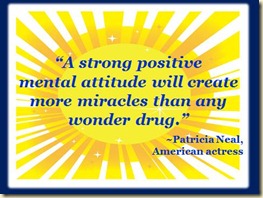 One of the best ways to do that is to keep an upbeat approach. We know that we are not living in an overly optimistic time period right now. With the problems we face on a day to day basis, it can make it hard to find the good that life has to offer. One of our favorite quotes, which is credited to Patricia Neal, addresses this: “A strong positive mental attitude will create more miracles than any wonder drug.” Life will bring us good days and bad, sunshine and rain, laughter and tears. We can’t always control the happenings in life but we can control how we react to them. Smile often and make that part of your daily routine! No matter how bad off we feel or think we have it, there is always somebody else out there worse off than us. We all need to extend our hands and our hearts to help others! One of the best ways to do that is to keep an upbeat approach. We know that we are not living in an overly optimistic time period right now. With the problems we face on a day to day basis, it can make it hard to find the good that life has to offer. One of our favorite quotes, which is credited to Patricia Neal, addresses this: “A strong positive mental attitude will create more miracles than any wonder drug.” Life will bring us good days and bad, sunshine and rain, laughter and tears. We can’t always control the happenings in life but we can control how we react to them. Smile often and make that part of your daily routine! No matter how bad off we feel or think we have it, there is always somebody else out there worse off than us. We all need to extend our hands and our hearts to help others!
We want to wish you all a very Happy and Healthy New Year! This is your year to shine. Don’t let anything stand in your way!
~It’s Your Health. It’s Your Life. Make That Change!
~Angie & John
Permalink
« Previous entries Next Page » Next Page »
|
| |
|
|